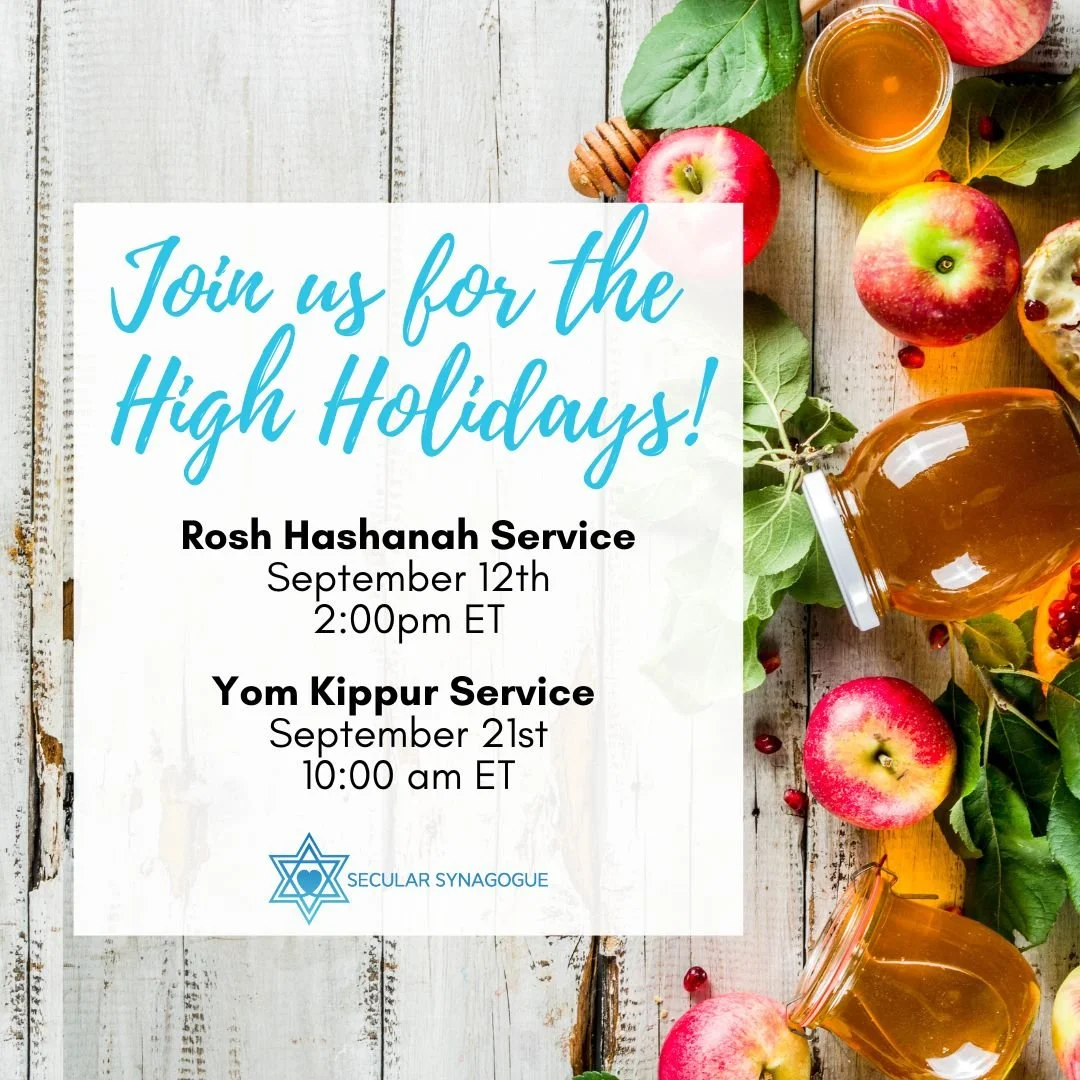
Rosh Hashanah sermon: Miracles and Magic
Many years ago I was in Costa Rica, walking on impossibly high rope bridges atop the canopy. I don’t have the words to describe the beauty. The vegetation was lush and full. The colours were vivid and enchanting, contrasting in a perfect way. Earlier that day, we had learned that the beak of a particular bird and the plant it feeds from have both evolved to be able to help one another: The plant’s shape shifting to be more like the shape of the beak. The beak’s shape sharpening to fit into the ridges of the particularly petal so it can pollinate it. I was astounded at all of this, truly feeling a sense of awe at what I could only describe as magic. Up on that rope bridge, experiencing what the Romantics called “The sublime,” a visceral sense of the danger, power, and stunning beauty of nature, a woman and I walked silently. A strange thought popped into my head: I wonder if all this can really just have been brought forth by evolution; accidents and tiny permutations over millennia. Might there be some sort of prime mover to create all of this? Just as I had that thought, the woman I was walking with, quietly up until that moment, suddenly asked: “Do you believe in God?”
Today is Rosh Hashanah, which is literally the head of the year; the beginning of the new year. It is also known as the birthday of the world.
The beginning of the Hebrew Bible, Genesis or Bereshit, begins:
Bereshit bara Elohim et hashamayim ve’et ha’aretz,
בְּרֵאשִׁ֖ית בָּרָ֣א אֱלֹהִ֑ים אֵ֥ת הַשָּׁמַ֖יִם וְאֵ֥ת הָאָֽרֶץ׃
When God began to create heaven and earth—
וְהָאָ֗רֶץ הָיְתָ֥ה תֹ֙הוּ֙ וָבֹ֔הוּ וְחֹ֖שֶׁךְ עַל־פְּנֵ֣י תְה֑וֹם וְר֣וּחַ אֱלֹהִ֔ים מְרַחֶ֖פֶת עַל־פְּנֵ֥י הַמָּֽיִם׃
the earth being unformed and void, with darkness over the surface of the deep and a wind from God sweeping over the water—
וַיֹּ֥אמֶר אֱלֹהִ֖ים יְהִ֣י א֑וֹר וַֽיְהִי־אֽוֹר׃
God said, “Let there be light”; and there was light.
In the translation and interpretation of that very first line we have the debate that swirled in my head all those years ago in Costa Rica. Some translate it as: When God began to create heaven and earth,” and others “in the beginning of God’s creation.” The question becomes: what created God? And also, what was God up to before creating the world? Genesis describes how for six days God created all things: water and sky, plants and creepy crawlies, animals and, importantly, human:
And God created humankind in the divine image,
creating it in the image of God—
creating them male and female.
Yes, the first human was both male and female. Pronoun: them. Or, if you see this as two humans, they were male and female, each created equally alongside the other. The rib and the apple come in the next chapter.
Rosh Hashanah is the time to consider creation, and renewal, of the world and of ourselves. In all kinds of ways, this time of year makes us ask: why am I here? This is a question of meaning and purpose, but also a question that gets at that wrestling between science and religion: atop the canopy do we think the trees are here because of evolutionary biology or divine creation? Jews believe differently on this question. But here is what I want to get at today: there is meaning in wrestling with the question and, more importantly, either and all answers could and should inspire awe. The awe is the thing.
The question of how humans come to be here has of course been central to all religions and philosophies throughout time. Little kids ask about this too.
In Barbara Kingsolver’s Animal, Vegetable, Miracle, a book about living for a year almost entirely on food she raised or grew, Kingsolver, a writer and botanist, is asked by her young daughter Lily about:
“The Big Question. I don’t mean sex, that’s easy. She wanted to know where everything comes from: beetles, plants, us…” “How lovely it might be to invoke for my child in just one or two quotes the inexplicable Mystery [aka Genesis]. But I went to graduate school in evolutionary biology which kind of obligates me to go into the details. Lily and I talked about the millions and millions of years, the seaweeds and jellyfish and rabbits. I explained how most creatures have many children (some have thousands!) with lots of small differences between them. These specialties — things like quick hiding or slow, picky eating, or just shovelling everything in — can make a difference in whether the baby lives to be a grown-up. The ones that survive will have children more like themselves. And so on. The group slowly changes. I’ve always thought of this as a fine creation story, a sort of quantifiable miracle.”
A “quantifiable miracle” is a stunning thought. Her book’s title, Animal, Vegetable, Miracle, invokes this idea. She is a scientist and understands better than most of us exactly where her food comes from. She did the work of the planting and the feeding and the harvesting. But at the end, the symbiosis between our bodies and the land that feeds us. Miraculous.
We can tap into that each time we eat. Many Jews say a blessing thanking God for their food. Many do not. But there is a world of difference between saying a blessing by rote and then “shovelling it in” and really connecting with the land and farmers and grocery workers who brought food to table and sitting with the delicious flavours, whether or not we pray. Most of us here are lucky enough to experience these small bounties every day. Whether we connect with a blessing or gratitude or presence, the awe is the thing.
Regardless of our theistic belief, we are surrounded by small miracles. But most of us are too busy, tired, overwhelmed, angry, exhausted, to feel them. That’s on purpose: it is the playbook of the fascists to keep us overwhelmed and exhausted. But that is precisely why it is our job to experience the quantifiable miracles around us as best we can. It helps ground us in our shared struggles. It helps nourish us. And it reminds us of all the beauty in humanity and the natural world that is worth protecting.
It was about twenty years after that Costa Rica trip when I read Robin Wall Kimmerer’s Braiding Sweetgrass, and I learned why those colours I had seen were just so, complimenting each other so beautifully. Kimmerer, like Kingsolver, believes in blending art and science. She thought there was a reason that the colours of purple astors and yellow goldenrod work so perfectly. And there is. Pollinators are attracted to such contrasting and complementary colours, just like we are. Necessity and beauty exist in a marriage. Both these writers use their scientific backgrounds to create a sense of wonder and awe in their writing. They reject the false binary between art and science. And I reject the false binary between religion and science. There is awe in all of it.
On this “birthday of the world,” the first day of creation as described in Genesis, if you take it literally, or the day that Jews have mutually agreed to come together and contemplate creation, let us reflect. Picture the most beautiful sunset you’ve seen. Can your mind capture its colour? Was it peachy or pink? Were the clouds fluffy or wispy? Each evening, wherever we are in the world, the sun sets. What a thought.
Years ago, Conservative pundit Bill O’Reilly referenced the fact that the sun rises and sets each day as proof of God. People made fun of him for eliding the very basic understanding of how the earth revolves around the sun. I don’t see it as proof of God. But I do see it as something that can inspire awe. Here we are, on this “pale, blue dot” in the words of Jewish Humanist astronomer Carl Sagan. And that blue dot spins in the vastness of space. Just wow.
I actually find it more awe-inspiring to consider the workings of nature without the idea of a God. If there’s an all-powerful being than, you know, sure, they can create a planet. But the intricate coincidences that had to happen for our world to be here, and for each and every one of us to be here, that is a quantifiable miracle indeed.
Many years ago with my own daughter who had asked me where babies come from, I was reading Cory Silverberg’s excellent children’s book “What Makes a Baby?,” which talks about all the stories contained in an egg and in a sperm get together and dance and out of that dance comes a baby. My daughter exclaimed: “you are explaining to me the miracle of life!”. Yes indeed, my baby. It is a miracle that you are here. All the possible combinations from hundreds of eggs and millions of sperm and all the people whose bodies hold them, it is so, so unlikely that any one of us is here. Yet here we are. And on a planet that can sustain us, in water, food, temperature, and all that we need to thrive, as long as we protect it. How awe-inspiring is that?
I think those of us who see ourselves as atheists, agnostics, etc. can sometimes miss out on all of the meaning that comes from these moments of awe.
I was ordained by the Secular Humanistic Jewish movement, of which I am still a proud part. I have always loved Judaism’s focus on the awe and wonder of life. We toast l’chaim. We give tzedakah in multiples of 18, for chai (life in Hebrew). We teach that to save a life is to save a whole world. I found in Humanistic Judaism many who come to deep and serious cultural practice because of their commitment to life: making their own as whole and good as possible, to help us world become as whole and good as possible.
I also found others I would describe as “glatt secular” (a joke by my friend and teacher Rabbi Adam Chalom). Glatt refers to the highest adherence to Kosher laws. A striving for a kind of purity.
Any reference to spirituality is offensive to these folks. I want to be respectful here because I understand that religion has been a force of traumatic experience in the lives of many, and its impact on the world from religious fundamentalists of all kinds has been on the whole…. Not great. But to resist a sense of the spiritual can be (isn’t necessarily but can be) a way to structure one’s life around resisting awe. These folks can be quite dogmatic about avoiding talking about “magical thinking.” But I am drawn to this movement because I am repelled by dogma. And just as I resist religious dogma telling me what to do, I resist secular dogma as well! I really do want to think and talk about “magical thinking.” Not the way they mean it, which invokes the supernatural. But I mean thinking about the magic that is all around us. And being grateful for it.
People sometimes describe Humanistic Judaism as “Rational Judaism,” a term which always rubbed me the wrong way. I don’t think Judaism is irrational, but the point and substance of it goes beyond reason. This is, in my view, a patriarchal way of looking at religion and culture: separating head from heart; cognition from somatics. To me, Judaism is about the head, heart, body, and beyond. Whatever I might think of as neshama, or soul, or essence. Sure, these might just come down to genes and synapses, but I am talking about whatever it is that makes me me, or you you. So much of what we know is real in life is ephemeral: creativity, empathy, aspiration, love. Wherever it comes from is actually irrelevant. The awe is the thing. Let us revel in the magic, the quantifiable miracles, of the human experience.
Secular Synagogue community members will know that what prompted this talk is a funny accident or coincidence that happened to me. I am part of a group of Jewish women who meets for Rosh Chodesh, the new moon. We have come to call ourselves the coven. In July when I had surgery, coven members helped me greatly with rides to and from the hospital, and material support. A couple of days later I biked down to my local beach (on Lake Ontario!!) and was sitting with a book. I need you to understand, this is a very, very large beach. Several kilometres of shoreline stretch out at the bottom of the city. But I looked up and walking towards me, without even realizing it, were members of the coven with their kids. They did not know I was at the beach. I did not know they were coming. We had never met at or even spoke about that spot, my favourite along that long shoreline. They just happened to show up right then, right there.
Some call moments like this coincidence or synchronicity or serendipity. I don’t know what I call it. I genuinely don’t believe there is a God out there who thought it would be funny to have my coven members and I run into each other. If there is, I humbly ask God to focus on more important things!
I do think it was an accident, a happy one!, that brought us together, just as I think it’s an accident that each and every one of us got born. But that doesn’t mean it isn’t magical!
What a delight to see these women and their kids right as I am recovering! It was a beautiful reminder of the power of community. This coven had just supported me. Because my kids weren’t with me, I could step into a small caretaking role with some of their little ones in kind, making sure they didn’t wade in too deep or stray too far. We weave together, the coven but also us here, and all of us in our worlds, a web of community care. Sometimes we help weave that web, and sometimes we are held by the web ourselves. (This idea is from Kohenet Keshira Ha Lev Fife). There’s magic in that too.
We humans create communities, cultures, even covens. We know the value of coming together.
We especially know this in Judaism, which insists that communal participation is part of how we do Jewish. We need a minyan of ten people to pray. Judaism continually tells us, sometimes literally, that we should not separate ourselves from the community.
But community can be hard. There are politics and polarizations. There are dynamics and dirtbags. I will talk more about this at Yom Kippur when I discuss the politics of exclusion in Jewish life, from Intermarriage to Israel/Palestine.
But that’s for the day of atonement and mourning. Today is the day of wonder and celebration. It is the figurative birthday of the world and all of its parts. And each year at Rosh Hashanah is an opportunity to take stock. Who and how do you want to be this year? I want to be awe-filled (not “awful” but “awe-filled”!). I want to revel in the quantifiable miracles and serendipitous moments of magic. I want to pause to connect with land. I want to deepen my gratitude for sunsets and sustenance. I want to be in this life, really in it, for as long as I get to.
This will require slowing down. This is not easy in a world of many demands and urgent need. But it is my commitment to try to intentionally slow it down this year. That doesn’t only mean doing less. That means doing what I do with more purpose and presence. I have even been working on brushing my teeth more slowly.
The great technology for slowing down in Jewish life is Shabbat. Secular Synagogue members will be talking more about Shabbat practices in the months to come.
But all of us, and at any time, have access to our breath and body. We can appreciate the sky and sun and stars from anywhere. We can treat our awe and delight with sacred purpose and imbue it with spiritual meaning. Rosh Hashanah asks us to ask and try answer the question: who are you and why are you here? If we slow down enough, we just might hear in ourselves the answer this year. And that starts right here with what we call the Days of Awe. Wherever you are on the secular to supernatural spiritual spectrum, may 5787 be a year of magic, mystery, miracle. And when the magic appears to be dull or lacking, let’s make some of our own. Shana tova, dear community.